
AI is making its way everywhere, promising productivity and efficiency. But by delegating without discernment, companies risk automating their own dysfunctions. In this article, Silvan Cabot warns against giving AI the mission to go faster… when what we really need is to do better first.
A friend recently explained to me that AI-assisted note-taking had been a game-changer in his Executive Committee. He told me that they finally had a summary and a list of tasks at the end of each meeting. I think they have one more bot to make bad meetings immortal.
Most generative AI tools I see coming to market today are focused on speeding up low-value tasks. Very few address deep problems or enable new things.
We are still at the stage of faster horses.
Natural selection will eventually take place, but we can get ahead by seeking operational excellence rather than accelerating what already exists.
The Automation of "Junior Corporates"
I see current AI note-taking tools as a digital version of corporate interns. If you have experience in large organizations, you know what I'm talking about: brilliant young people used to taking notes, following up on tasks, and scheduling "sync points."
I once saw one of these interns transfer hundreds of Post-it notes from an ideation workshop into Excel, to "ensure no good idea was lost." Then, I saw him organize a workshop to "identify patterns" in what was, initially, an unfiltered brainstorming session to build connections between people who didn't know each other.
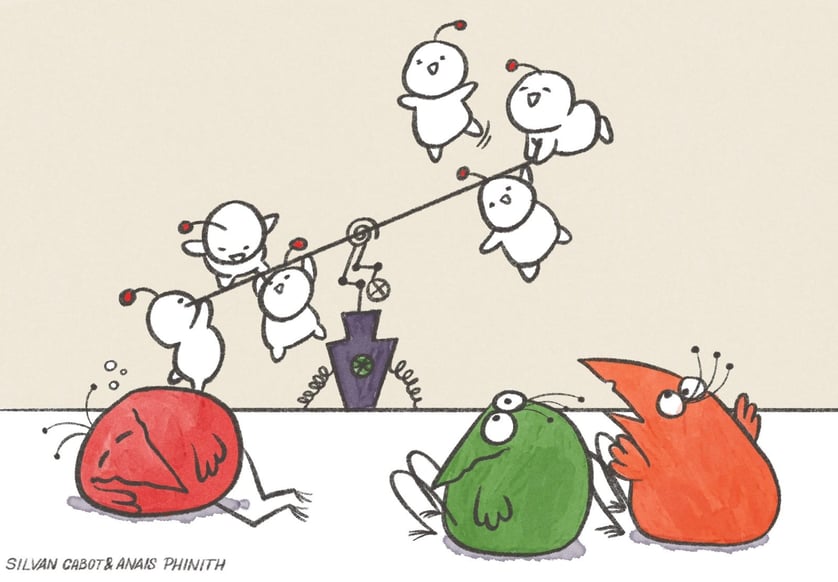
This is the danger of inexperienced and poorly supervised people: they don't just carefully preserve bad ideas, they amplify and accelerate them. They take flawed processes and make them more efficient: they normalize dysfunction. They do what they're asked, with formidable efficiency but without perspective.
The good news is that humans learn. Those who take notes today are the leaders of tomorrow. With time, they understand the nuance between what is asked and what truly matters. They develop their judgment. AI, on the other hand, does not learn (not in this sense): it simply amplifies the noise and will continue to do so as long as it is not asked for something else.
Same problems, new tools
We have replaced humans with AI, and we give them the same specifications. Everyone now has their own intern. Walk into a meeting, and you'll find 20 humans alongside 20 machines. They are there. A silent presence with perfect memory. Recording every word and spitting out task lists faster than you can say "action item."
Everyone feels more productive, but nothing really changes: we automate defective processes instead of correcting them. Recent studies indicate that 83% of employees spend up to a third of their work week in meetings, but only 11% of these are considered productive. In the United States alone, the cost of unproductive meetings amounts to $399 billion per year.
My friend's Executive Committee didn't have a note-taking problem. It had an alignment problem that could stem from very different things: overloaded leadership, biased meetings to force artificial engagement, topics disconnected from strategic objectives, gaps in responsibility definition... or, probably, a mix of all of that.
An intern asked to follow up with people has never solved a deep problem. AI note-taking won't either. It will document dysfunction more efficiently.
Efficiency is not always the most important thing
I talk about note-taking because it's a very common tool, but it's just an illustration. I'm not "against" AI meeting summaries, any more than I'm "against" corporate interns. The automatic ToDos at the end of each meeting didn't solve my friend's Executive Committee problem, but it allows him to be a little more at ease in his daily work. That's already pretty good.
I also know that there are note-taking assistance tools with a different promise. Granola, for example, doesn't promise to do things faster but to do them better by helping us improve our personal notes.
Doing better is what we should expect from our productivity tools first and foremost. Let's do better today; we'll do faster when doing fast is truly differentiating.
When we ask generative AI to produce deliverables that already existed 10 years ago faster, we put them at the service of these deliverables. Not at the service of our business.
A few examples to illustrate what I mean.
Asking AI to write specifications or user stories will not accelerate your Time-to-Market if you don't collaborate with development teams.
I have seen many different ways of writing specifications, and I have found that the best ones are not the most complete; they are those that have been done in close collaboration with teams.
The definition of a good specification will change from one team to another, or even from one person to another with the same team. If you simply ask an AI to produce the most complete document possible, you will get a complete document. But you will not necessarily have team alignment.
We will surely see optimized tools for collectively writing specifications arrive very soon, and in the meantime, AI can help you make better specifications... but not faster.
The time needed for real alignment can’t be compressed.
- Keep sharing your drafts or preliminary versions with development teams.
- Make sure they can react very early, often, and at low cost.
- Have them participate in the writing.
- Do not force them to read a 30-page document to start discussing. Especially if you didn't bother to take the time writing it yourself.
Asking AI to build a complete prototype will not allow you to make better decisions if you don't have a real validation plan.
On paper, the promise is tempting: I quickly make a prototype, show it, and immediately know if people will like it or not. It looks like a solid hypothesis/validation approach, but in reality, this "test" won’t help you make good decisions.
Whatever the reaction of the people you test with, you will have learned nothing. They like it? You don't know why, and you'll tend to confirm what you think. They don't like it? You don't know why, but you'll tend to find a bad explanation that confirms what you think.
You will learn nothing if you don't break down your prototype to conduct a series of experiments that isolate the true differentiating factors.
You don't want to prototype faster; you don't want to test faster either; you want to increase the predictability of your product's return on investment.
Asking AI to synthesize thousands of feedback notes will not help you better understand your customers if you don't talk to them.
Here too, the promise looks like a good idea, but processing a huge amount of data has never been a guarantee of quality. In fact, it’s quite the opposite: an illusion of rigor that masks a confirmation bias machine.
The more feedback you process, the more you increase the chances of finding people who say what you want to hear. Especially when it's analyzed by an AI that already tends to do so.
Again, AI processing can help you, but use it to develop better working hypotheses, not to validate them.
Then, go talk to your customers. Go talk to their friends. Go talk to your non-customers. The world is full of people who will not spontaneously send you feedback and who can teach you a lot about your product.
Back to basics
It seems that every article written in 2025 must include a paragraph starting with "In the age of AI". So this is my conclusion:
In the age of AI, we are introducing productivity tools into our operational models even faster, without evaluating whether they will solve our real problems or create new ones.
Nothing really new, after all.
The right questions to ask about internal operations and new tools haven't changed:
- What problem are we trying to solve?
- How will we measure that we are truly solving it?
- How will we ensure that we are not creating other problems?
Make sure you can answer these three questions before rushing into a new solution. These have been the same three questions for a long time, but they are solid and proven. They will allow you to avoid false shortcuts.
We’re starting to see some really interesting things on the market, and there will be more and more. We can already make much better use of our time thanks to these new tools.
You just have to avoid asking them to do the same thing, only faster.
Tired of investing blindly in AI? Discover Thiga’s AI Product Canvas, with all the right questions to ask before kicking off your next AI project.


.png)